
Tata Motors 2026 Key Takeaways: JLR Challenges, China Slowdown and Future Outlook
Contents
Tata Motors Q3 FY26 Concall: Understanding JLR Problems and What Investors Should Expect Next
The Q3 FY26 earnings call of Tata Motors Passenger Vehicles gave investors a very important update about the company’s current situation. The results clearly show a mixed picture.
On one side, the India passenger vehicle business is performing very well. Sales are growing, new products are receiving strong demand, and the company is gaining market share.
But on the other side, Jaguar Land Rover (JLR) continues to face several challenges. These problems have affected the overall financial performance of Tata Motors.
For investors, the key question now is simple: When will JLR recover?
In this article, we will break down the major points from the Q3 FY26 concall and understand what it means for long-term investors.
Overall Financial Performance
Let us first look at the consolidated numbers of Tata Motors for Q3 FY26.
The company reported:
- Consolidated revenue of about ₹70,000 crore
- Revenue decline of 26% year-on-year
- Consolidated EBIT margin of –4.7%
- Loss before tax of about ₹3,100 crore
- Negative free cash flow of about ₹18,000 crore
These numbers may look disappointing at first glance.
However, it is important to understand that most of the pressure came from JLR. The India passenger vehicle business remained relatively stable.
The group’s net debt has increased to around ₹39,000 crore, mainly due to the cash burn in the JLR business during the quarter.
So clearly, the future performance of Tata Motors depends heavily on how JLR performs in the coming quarters.
Cyber Attack Impact on JLR
One of the biggest issues affecting the quarter was the cyber incident that disrupted JLR operations.
This incident caused a significant production loss.
Production Loss
According to management:
- Around 50,000 vehicles of production were lost
- Wholesale volumes dropped to 59,100 units
- Last year in the same quarter, volumes were over 100,000 units
This large drop in production directly impacted revenue and profitability.
Financial Impact
The cyber disruption also created operational complications.
The company had to:
- Restart systems
- Clear supplier payments
- Pay delayed invoices
Because of this, JLR reported:
- EBIT margin of –6.8%
- Large negative cash flow during the quarter
The management also confirmed that most of the cyber-related financial impact was seen in Q3.
The positive news is that production has now normalized, and factories are running at full capacity again.
So the cyber issue itself is largely behind the company.
The Bigger Problem: Structural Challenges at JLR
While the cyber incident was temporary, the bigger challenge for JLR is the changing global business environment.
Management clearly admitted that the operating environment has become more difficult in several areas.
These include tariffs, weak demand in China, rising incentives, and currency fluctuations.
Let us understand these issues one by one.
Tariffs Are Increasing Costs
Tariffs have become a major problem for JLR.
During the first nine months of FY26, the company had to pay about £410 million in additional tariffs.
These tariffs mainly affect exports to the United States and some other markets.
The company tried to offset this cost by increasing prices and delivery charges. However, intense competition forced the company to increase sales incentives, which reduced the benefit of those price hikes.
This means tariff pressure may continue to affect margins in the near term.
Weak Luxury Car Demand in China
China is the largest automobile market in the world, especially for luxury cars.
But the situation there has changed significantly.
According to management:
- The premium car market in China is down about 21%
- JLR sales in China have declined around 26%
There are several reasons for this.
First, domestic Chinese electric vehicle brands are becoming very strong.
Second, the Chinese government has introduced additional taxes on luxury vehicles.
Third, the market currently has too many dealerships and excess capacity, which has pushed thousands of retailers into financial trouble.
Management clearly said that this change in China is structural rather than temporary.
This means recovery may take time.
Rising Sales Incentives
Another important issue discussed in the concall was the increase in sales incentives.
To maintain demand in competitive markets, JLR had to offer higher incentives.
Retail incentive levels increased to about 7.7% of sales in Q3, compared with 4.2% last year.
Higher incentives help maintain sales volumes but reduce profit margins.
Management expects incentives may rise slightly in the next few months but should stabilize later as new models are introduced.
Warranty Costs Also Increased
Warranty costs also affected the quarter.
JLR had to make additional provisions related to product campaigns and vehicle buybacks in the United States.
These were largely one-time events, so the company does not expect such high warranty costs every quarter.
This should help margins improve slightly going forward.
Currency and Raw Material Pressure
Currency movement also played a role in the weaker performance.
A weaker US dollar reduced revenue when converted into British pounds.
At the same time, some raw material prices increased, adding further cost pressure.
Although hedging protects the company for short periods, long-term currency trends could still impact profitability.
Strong Performance in India Passenger Vehicle Business
While JLR faced challenges, the India passenger vehicle business performed strongly.
Key highlights include:
- Revenue growth of 24%
- Record wholesale volume of about 171,000 vehicles
- Retail sales crossing 200,000 units
- Market share improving to 13.8%
The Indian passenger vehicle industry is benefiting from strong SUV demand and GST rate cuts.
Tata Motors has several popular products in the market, including Nexon, Punch, Harrier, Safari, and Sierra.
Demand for these vehicles remains strong.
EV Business Continues to Grow
Tata Motors remains the leader in the electric vehicle segment in India.
Important numbers from the quarter:
- EV sales grew about 50% year-on-year
- EV market share around 46%
- More than 2.5 lakh Tata EVs already on Indian roads
The company’s EV strategy focuses on multiple price segments and expanding charging infrastructure.
Management believes EV demand will continue to grow strongly in the coming years.
Sierra Launch Is a Big Positive
One of the most exciting developments for the domestic business is the launch of the Sierra SUV.
The response from customers has been extremely strong.
The company received 70,000 bookings on the first day itself, and total bookings are already in six digits.
Currently, the waiting period is about 6–7 months.
Production is gradually increasing as supplier capacity improves.
If this product continues to perform well, it could become an important growth driver for Tata Motors in India.
Future Product Pipeline for JLR
Despite the current challenges, JLR has an exciting product pipeline.
Management confirmed several important launches over the next two years.
Key Upcoming Models
- Range Rover Electric
- A completely new Jaguar electric vehicle
- A new model based on the EMA platform
- Future Freelander vehicles from the China joint venture
These launches will take place over the next 24 months.
If these vehicles are successful, they could significantly improve JLR’s profitability.
Debt Position and Cash Flow
Another concern for investors is the increase in debt.
The group’s net debt currently stands at around ₹39,000 crore.
Earlier, JLR was moving toward a net cash position. However, the cyber incident and negative cash flow reversed that progress.
Management clearly said that returning to a net cash position will not happen in the next two or three quarters.
Debt reduction will take time.
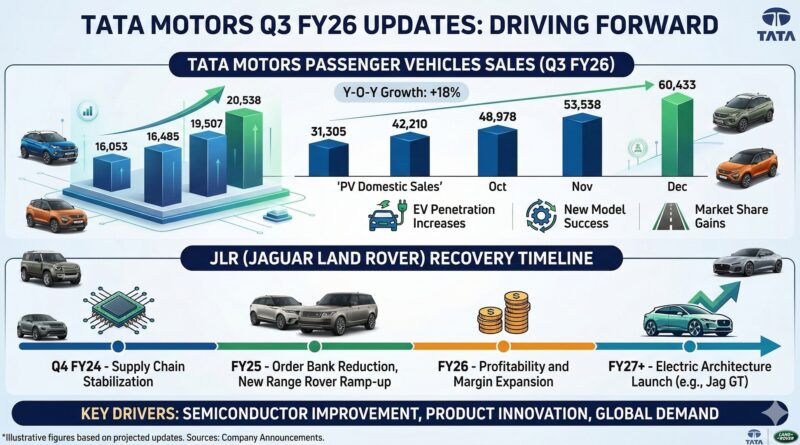
When Can JLR Recover?
Based on the Concall discussion, JLR recovery will likely happen in stages.
Phase 1: Operational Recovery (FY26)
Production has already returned to normal after the cyber disruption.
Q4 FY26 should show improvement in production and cash flow.
However, profitability may still remain weak.
Phase 2: Stabilization (FY27)
In FY27, several new products will begin launching.
Incentives may stabilize and operational efficiency could improve.
Margins may start improving gradually.
Phase 3: Structural Recovery (FY28 and Beyond)
The real turnaround could happen when:
- New EV models succeed
- China demand stabilizes
- Tariff pressure reduces
- Incentives decline
So the full recovery may take two to three years.
Final Thoughts
The Q3 FY26 earnings call of Tata Motors Passenger Vehicles shows that the company is currently going through a transitional phase.
The India passenger vehicle business is performing strongly with rising demand, strong EV growth, and successful new product launches.
However, the group’s overall performance is still dependent on Jaguar Land Rover, which is facing several global challenges.
The cyber incident that affected production appears to be resolved, but structural issues such as tariffs, China demand slowdown, and higher incentives will take time to normalize.
For investors, the key takeaway is this:
JLR’s problems are temporary but recovery will not be immediate.
The real turning point for Tata Motors will depend on the success of the upcoming product cycle, especially the electric Range Rover and the new Jaguar platform.
If these launches succeed and global luxury demand stabilizes, Tata Motors could return to strong profitability in the next few years.
Until then, investors should expect gradual improvement rather than a quick turnaround.
Disclaimer: This article is for informational purposes only and should not be considered investment advice.